


The Rise of Brazilian Steakhouses
Some food traditions remain deeply connected to the places where they originated. Others cross borders and gradually become part of global culture. Brazilian churrasco belongs to a rare category: a regional culinary tradition that evolved into an internationally recognized dining experience.
Today, Brazilian steakhouses can be found in cities such as Boston, Miami, Orlando, Santiago, Dubai, New York, and many others. What once emerged from Southern Brazil now occupies hospitality districts, business centers, and restaurant destinations across multiple continents.
Its expansion, however, was never simply about grilled meat.
Brazilian steakhouses introduced a different way of experiencing food: one built around movement, hospitality, ritual, and gathering.
The Origins of Churrasco and the Gaucho Tradition
The roots of Brazilian churrasco are closely associated with Rio Grande do Sul, the southernmost state of Brazil and home to the traditional gaucho culture.
Historically, gauchos were horsemen and cattle herders who lived and worked across the grasslands of Southern Brazil, Argentina, and Uruguay. Large cattle regions and long working days naturally created practical cooking methods centered around open flames and simple preparation techniques.
Rather than relying on complex seasoning, the focus was placed on:
- fire
- quality cuts
- preparation technique
- patience
- shared meals
Over generations, what began as a practical form of cooking gradually evolved into one of Brazil’s strongest culinary identities.
Brazilian Churrasco Became Larger Than Southern Brazil
Although Southern Brazil helped establish the foundations of churrasco culture, its expansion happened through multiple regions and communities over time.

As migration patterns shifted and urban centers grew, Brazilian barbecue traditions evolved across São Paulo, Paraná, Santa Catarina, and other regions of the country. Different interpretations emerged while preserving core principles associated with hospitality and open-fire cooking.
What the world recognizes today as a “Brazilian steakhouse” is the result of decades of cultural adaptation rather than a single regional influence.
More Than Meat: Understanding the Churrasco Experience
For international visitors, Brazilian steakhouses are often associated with “all-you-can-eat” dining experiences. While unlimited service became one visible characteristic, the original concept extends beyond quantity.
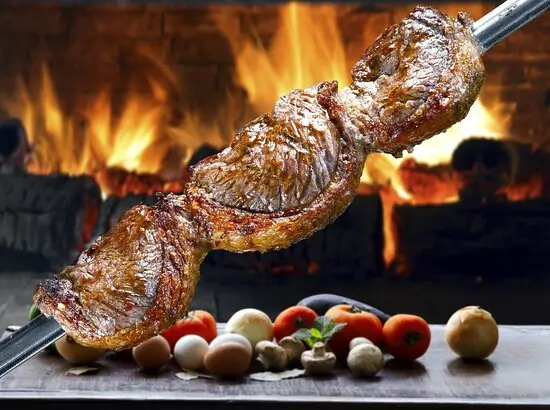
Traditional churrasco introduced elements that transformed dining into an experience:
- fire-roasted preparation
- gaucho tableside service
- rodízio-style dining
- continuous service rotation
- communal experiences
- hospitality-centered rituals
Unlike static dining formats, the experience itself became part of the attraction.
Brazilian Steakhouse vs Traditional American Steakhouse
Although both concepts focus heavily on premium cuts, their dining philosophies developed differently.
| Brazilian Steakhouse | Traditional American Steakhouse |
|---|---|
| continuous tableside service | plated service |
| rodízio experience | individual ordering |
| gaucho traditions | classic steakhouse traditions |
| communal atmosphere | individual dining format |
| rotating selection of cuts | menu-based selection |
This distinction helped Brazilian steakhouses create an identity that felt familiar enough for international audiences while still offering something different.
Why Brazilian Steakhouses Expanded Internationally
Several factors contributed to their global expansion.
Brazilian communities abroad
Large Brazilian communities in regions such as Florida, Massachusetts, and New York helped create early demand for familiar cultural experiences.
Dining as entertainment
The movement, interaction, and service style transformed meals into more engaging experiences.
Premium positioning
Brazilian steakhouses often occupied a unique space between upscale dining and cultural authenticity.
Strong international expansion models
Restaurant groups helped transform a regional dining tradition into a scalable global concept.
Over time, Brazilian steakhouses expanded beyond Brazilian audiences and became part of mainstream international dining culture.
Did You Know?
Many international visitors experience Brazilian churrasco for the first time before ever visiting Brazil itself.
For millions of guests worldwide, cities like Boston, Orlando, Miami, Dubai, and Santiago became their first introduction to one of Brazil’s most recognizable culinary traditions.
Brazilian Steakhouses Around the World
Today, Brazilian steakhouses operate across:
- United States
- Brazil
- Chile
- United Arab Emirates
- Mexico
- Europe
- additional international markets
While locations adapt to local audiences, many continue preserving traditions inspired by Southern Brazil.
Featured Brazilian Steakhouses in the dMix Listing
Restaurants helping expand Brazilian culinary experiences across different regions:
- Fogo de Chão — Orlando, Florida
- HH Brazilian Steakhouse — Los Angeles, California
- Flama Brazilian Steakhouse — Homestead, Florida
- More …
Additional Brazilian culinary experiences may be added as the dMix Listing ecosystem continues expanding.
Beyond Restaurants: The Export of a Cultural Ritual
Brazilian steakhouses became internationally successful because they exported more than menus.
They exported a ritual.
From the grasslands of Southern Brazil to dining rooms across multiple continents, churrasco evolved into a cultural experience capable of connecting food, identity, hospitality, and tradition far beyond its place of origin.
Explore More in dMix
🔗 dMix Brazilian Steakhouses
Discover Brazilian steakhouses and dining experiences across different regions and countries.
🔗 dMix Listing — Find Businesses, Products & Services
Explore Brazilian-owned businesses, international brands, and curated services connected to the global Brazilian community.
🇧🇷 Add Your Brazilian Business to dMix
Operate outside Brazil? Join the dMix ecosystem and expand your visibility among Brazilian communities worldwide.
The Origins of Gaucho Culture and Why Southern Brazil Became the Home of Churrasco
